
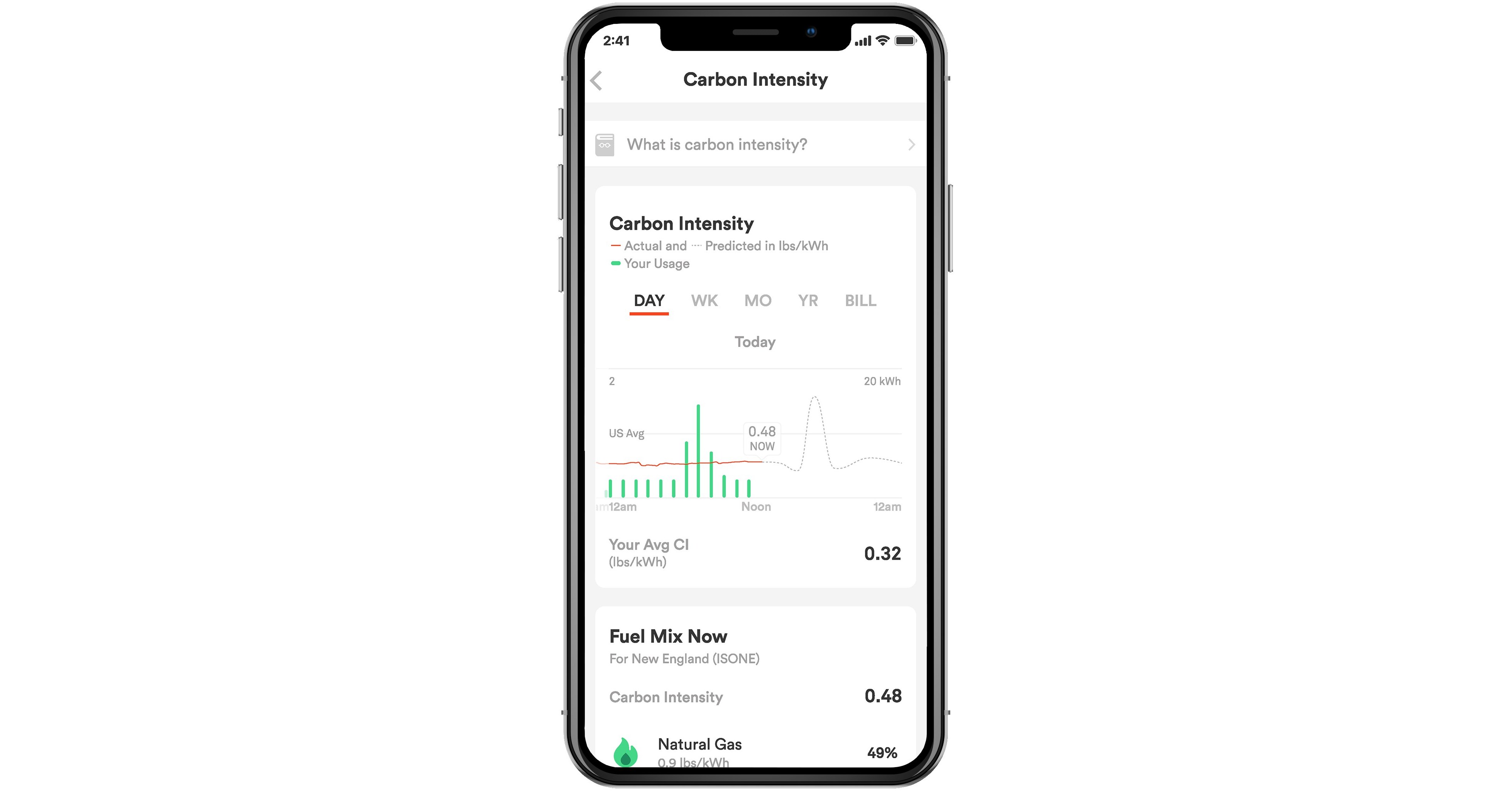
In addition to tracking the home’s carbon usage in real time, the Sense app has a forward-looking view that forecasts carbon intensity (CI), so users can schedule high-energy tasks, such as washing, washing dishes or recharging electric vehicles, during times when carbon emissions are lowest, thereby reducing their home’s overall carbon footprint.
In the app, users can also see a breakdown of the types of fuel that are powering the house at the moment. The energy sources on the distribution grid vary considerably from region to region, and regions change their energy mix over the course of a day, creating variations in the CI.
The new CI functionality is included in the Sense app for Sense Home Energy Monitor and Sense Solar. It is also included in all Sense compatible products, such as the Square D™ edition of the Sense app for energy wise™ Home Power Monitor and Square D™ Schneider Electric energy center.
What is carbon intensity?
Carbon intensity is simply the amount of carbon dioxide emitted to generate a specific unit of power. The average CI on the nation’s public grid is around 1 lb / kWh, which roughly equates to the CI for natural gas. Consumers can reduce their overall impact on climate change by being aware of CI and shifting energy use to times when the grid uses more green energy.
In most parts of the country, the carbon intensity of electricity produced by power plants varies throughout the day. At certain times of the day, such as when solar and wind power generate a lot of electricity, carbon emissions are low. At other times, electricity can come from sources that emit more carbon, such as coal or natural gas power plants, which increases the carbon intensity of electricity on the grid.
In regions that depend mainly on a single continuous energy source, such as hydropower or natural gas, the carbon intensity varies only slightly, while in others with various energy sources, the intensity carbon (CI) can rise and fall over the course of a day or week.
How Sense Reduces Carbon Emissions
The variability of CI offers Sense users an opportunity to actively reduce their own home’s impact on carbon emissions. In the Sense app, users can see their average IC and can see the current IC of the power they are using, which is based on the dynamic data of the power grid. regIonal balancing authority. The Sense app also displays a projection of carbon peaks and troughs over the next 12 hours. By scheduling activities when the grid’s CI is lowest, Sense users can lower their own home’s CI score and impact carbon emissions.
To provide this new functionality, Sense has partnered with Singularity and integrated with their Carbonara platform for real-time and projected CI. Carbonara analyzes and provides carbon intensity data to 30 grid balancing authorities across the country.
The Sense app already has several features that help homeowners reduce their home’s energy consumption and carbon footprint, including:
- Comparison of the HVAC efficiency of the house compared to similar houses;
- Comparison of the use of Always On from inactive devices such as consumer electronics versus similar homes; Always On consumes 23% of the electricity of an average household
- Alerts when there are significant changes in energy consumption;
- The ability to set goals within the family budget;
- Sense’s advanced machine learning, which identifies individual devices, including common gadgets and home appliances, tells you if they’re on or off, and reports on their power consumption, so you can find and replace them. energy intensive;
- Integrations with smart plugs to track and control devices; and
- Flex Add-on sensors to monitor the energy consumption of major household appliances.
How energy-smart homes can fight climate change
In the future, smart homes will be able to take advantage of these fluctuations in carbon intensity automatically by responding to real-time signals from the distribution grid. Sense CEO said Mike Phillips: “Since the Sense app now knows the carbon intensity of grid electricity, we can start automating activities around the home to take place when the carbon intensity is low. For example, in the future, Sense users will be able to schedule their dishwasher or EV charger to operate when the IC is lowest. Smart homes can know residents’ preferences (for example, that the EV should be charged and ready to drive by 7h00) and will take into account CI, energy costs and grid constraints to find the right times to use energy, which will lead to carbon and cost reductions and contribute to a more reliable electricity grid. This becomes more and more important as we electrify our homes and cars, and the grid uses more and more renewable energy. “
“Homes are fast becoming the biggest consumer of electricity and homeowners are realizing that many of the resources currently consumed to produce this electricity are having a negative impact on our environment,” said Michael mahan, Vice-President, Home & Distribution North America, Schneider Electric. “Now, greater energy intelligence is being built into homes, including smart electrical panels, providing information and tools that empower homeowners to modify their behavior, enabling them to impact change for improvement. the environment and their electricity bill. “
About Sens
Sense’s mission is to reduce global carbon emissions by making homes smart and efficient. We empower people to care for their homes and families while contributing to a cleaner, more resilient future. Founded in 2013 by speech recognition pioneers, Sense uses machine learning technology to provide real-time information on device behavior, even for devices that aren’t “smart”. Customers trust Sense for a wide range of uses, including monitoring their home appliances, determining if they have left appliances on, and identifying how to reduce their energy costs. Sense has received investments from two of the world’s largest energy technology companies, Schneider Electric and Landis + Gyr. Sense is headquartered at Cambridge, Mass. To make sense of your energy, visit: https://sense.com.
About Singularity Energy
Singularity Energy is enabling the future of decarbonization through actionable data and new algorithms. Carbonara, a carbon intelligence platform built by Singularity Energy, provides high-quality, actionable grid carbon data and a suite of innovative products, development APIs, and smart tools for businesses to build solutions. data-driven decarbonisation. Carbonara use cases include planning, reporting and optimization of decarbonization and electrification projects such as electric vehicle fleets, battery storage, smart devices and 24 hour clean energy and 7 days a week. Singularity Energy is a winner of the Harvard Physical Science & Engineering Accelerator, the Greentown Labs Bold Idea Challenge in partnership with Schneider Electric, the National Science Foundation Small Business Innovation Research Grant and an URBAN-X Cohort 09 company. electricity in precise information on carbon emissions, visit: https://carbonara.energy/
Press contact:
[email protected]
[email protected]
SOURCE Meaning
Related links
www.sense.com